
Explore North Africa’s Cultural Capital Staying at Tarabel Marrakech
- North Africa’s cultural capital – Marrakech – is a year-round destination, offering guaranteed sunshine even in the winter months
- Marrakech is undergoing a creative renaissance with new galleries and concept stores
- Stay at an elegant luxurious oasis in the heart of Marrakech blending Moroccan and French styles
- Tarabel Marrakech is described in the Louis Vuitton Marrakech guide as “one of the medina’s most closely guarded secrets…”
Travellers have long been drawn to the ancient city of Marrakech. The medina (now a UNESCO World Heritage Site), Kasbah and Royal Palace are must-see destinations for anyone wanting to observe the country’s unique culture. Visitors can lose themselves in the labyrinth of souks, barter for colourful rugs and exotic tea sets, and prepare to be intoxicated by the exotic aromas of street food.
But Marrakech is also a brilliant 21st-century city known for its fashion, style, music and storytelling. Beyond the labyrinthine alleys of the souk visitors will find beautifully curated spaces offering high-quality, locally crafted pieces. Many boutiques feel more like private residences than traditional stores.
Marrakech is undergoing a creative renaissance. And art is the heartbeat of the city. Visitors will find new galleries in magnificent palaces and Art Deco buildings, and even a former bus station, celebrating art from Africa’s 54 countries.
There’s so much to see – and do – all year round. In that spirit, Tarabel Marrakech, the independently-owned discreet luxury boutique hotel located in the magnificent Dar El Bacha district, has put together an insider’s guide to the city – made up of 15 key moments.
Whether you’re with fellow travellers or visiting solo, this is the coolest itinerary to explore the city.
1. Moro Marrakech
Concept store Moro is a hidden gem in an inner courtyard filled with citrus trees, off Rue Yves St Laurent. Here you’ll find ceramics, jewellery, accessories and fashion from small-scale Moroccan designers and makers, displayed on elegant, arch-shaped shelving. The collection focuses on high-quality, ethically sourced goods that reflect a blend of contemporary style and Moroccan heritage. There’s playful eyewear from Baars x Gogosha; babahomme leather washbags and loungewear; and embroidered lace dresses from Hind Lamtiri. The store was created by artist Mohcyn and entrepreneur Mouad, founders of the natural cosmetics brand, The Moroccans. There’s also a chic cafe: so drop in for a healthy lunch of aubergine gratin and lemon and basil pie and then browse the collection.
2. Jardin Majorelle and Yves Saint Laurent Museum
The vibrant Majorelle Garden is a botanical garden created by French Orientalist artist Jacques Majorelle in the 1930s, with a Cubist villa designed by French architect Paul Sinoir. The walled complex consists of a labyrinth of intersecting paths and boldly coloured Moorish Art Deco buildings. The special shade of bold cobalt blue was inspired by the coloured tiles seen around Marrakech. The garden and villa sadly fell into disrepair but were rediscovered in the 1980s, by fashion designers, Yves Saint-Laurent and Pierre Bergé who set about restoring the property. Today, the villa houses the Berber Museum (which gives a fascinating insight into this unique culture and includes artefacts from YSL’s personal collection) and in 2017 the Musée Yves Saint Laurent opened nearby. When Saint Laurent died in 2008 his ashes were scattered in the Majorelle Garden.
3. Monde des Arts de la Parure (MAP)
A unique location in the heart of the Kasbah, The MAP exhibits nearly 7,000 ornaments, jewellery, clothing, textiles, and other ethnographic objects, collected over 40 years by a Swiss couple Marlène and Paolo Ponce-Gallone, who have spent their life travelling to the Middle East, Turkmenistan, Pakistan, Turkey, Yemen, Burkina Faso, Syria, Tunisia, China and India. They brought in French architects Joseph Achkar and Michel Charrière to design a new building to house their collection which has a focus on “parure” (adornment). The magical space is built from red pisé (a traditional technique using a type of rammed earth), with two floors of exhibition space and a garden restaurant on top.
4. The Museum of African Contemporary Art Al Maaden (MACAAL)
For four decades, the Lazraq family in Morocco has been amassing a collection of modern and contemporary African art. And now, the collection has a new permanent presence at the Museum of African Contemporary Art Al Maaden (Macaal). Designed by French architect Didier Lefort, the museum is structured in a distinctive “O” shape inspired by the layout of a traditional riad with an indoor garden and courtyard, allowing an effortless flow between indoor and outdoor spaces. Work includes photography, painting and sculpture, textiles, video art and installations from the majority of Africa’s 54 countries. Look out for Moroccan pioneers such as Farid Belkahia, Mohamed Melehi; Sudanese painter Salah Elmur; and Malian photographer Malick Sidibé.
5. Musée des Confluences (Dar el Bacha)
Dar el Bacha in the Medina currently houses the Museum of Confluences. A stately home built in 1910 for the Pasha of Marrakech, it’s a beautiful example of traditional Moroccan architecture, with fountains and orange trees in a central courtyard, plus a traditional hammam; douiria (for palace servants); a library and “harem” for the Pasha’s family. It has played host to the likes of Winston Churchill, Franklin D. Roosevelt and, more recently, Meryl Streep and Owen Wilson. After World War II, the palace was closed but in 2017, it was transformed into a public museum called the Museum of Confluences, in recognition of the multiple cultures that call Morocco home. And the luxurious coffee shop Café Bacha offers the finest varieties of coffee from 30 countries.
6. MCC Gallery (Marrakech Contemporary Collection)
Recognised as one of the leading contemporary art galleries in Marrakech, MCC started off in the heart of the medina, and is now located in Sidi Ghanem, a former industrial zone, dubbed the design district of Marrakech. Sidi Ghanem is where the style crowd are looking for the next big thing from fashion and art, to homeware and food. MCC was founded by Fatima-Zohra Bennani Bennis to invite Moroccan and international artists to step outside their comfort zone. The gallery which reopens on 25 August showcases painting, sculpture, photography, and mixed media installations, highlighting emerging talent as well as established names.
7. Maison de la Photographie
Founded by Hamid Mergani and Patrick Manac’h, the maison aims to showcase the extraordinary diversity of Morocco, through the eyes of visitors (both famous and unknown) from the birth of photography to the modern period: 1879–1960. Among the 10,000-strong collection are photographs (of Morocco and Africa), a rare set of 800 glass plates on the High Atlas, postcards, newspapers, maps, and documentaries.
8. Musée d’Art et de Culture de Marrakech (MACMA)
The Marrakech Museum of Art and Culture is the brainchild of gallery owner and collector, Nabil El Mallouki. Housed in a new building by architect Amine Tounsi (with tall Moroccan doors fusing ancient and modern influences) it’s located in Gueliz, near the Majorelle and Yves Saint Laurent museums. MACMA is an intriguing modern art space that displays everything from European and Orientalist painters to vintage cinema posters.
9. Fondation Montresso
An artist residency and art space located approximately 20 km from Marrakech, it was established in 2009 by the Montresso Art Foundation, and spans over 10 hectares of land planted with centennial olive trees. The residency offers artists from around the world a tranquil environment to develop their projects, providing them with studios, living spaces, and access to materials and assistants. The foundation also organises exhibitions and events to showcase the artists’ works and foster cultural exchange.
10. DaDa Marrakech
Dubbed “a living laboratory”, DaDa in the Jemaa el Fnaa market in the medina, is home to art, music and culinary shows. The modernist facade of DaDa is a lively contrast to its historical surroundings; tangerine concrete domes line the pavement outside the building and abstract contemporary art covers the facade. There’s an art gallery, bookshop, restaurant, bar, concert space, and speakeasy. DaDa was originally a bus station where the owner, Kemal Lafitmi’s grandfather worked as a local driver.
11. Comptoir des Mines Galerie (The Mines Counter Gallery)
Built in 1932, the Comptoir des Mines, an Art Deco gem, originally housed a mining trading company. The building was abandoned in the 1990s. But then in 2016, as part of the Marrakech Biennale, gallerist Hicham Daoudi decided to revive the building, transforming it into an atypical art venue, to support the local art scene. The large “CM” written in gold mosaic on the floor at the entrance welcomes visitors. In 2021, Comptoir des Mines launched MAJAZ, an artistic incubator to help emerging artists realise their first solo exhibition.
12. The Different Concept
A beautifully curated store selling men’s and women’s wear, bags, jewellery, plus ceramics and rugs, Different is located on Rue Amsefah in the middle of the medina. Think modern-cut tunics, jumpsuits, scarves and flowing dresses. “The staff made me feel like I was in a Hollywood movie getting a makeover,“ raves one fan. “I was invited to a theme party and had no idea what to wear – the staff styled me from head to toe.” Different was set up by Salah (Moroccan) and Jan (Belgian) who create their own collections made in Morocco, and select fresh new talent from all over the country. The rooftop restaurant Soulfood is very stylish.
13. Les Nomades de Marrakech
For generations, Namous Abderrahim and his family have been bringing their one-of-a-kind carpet creations to the world. No two rugs are exactly alike, and their showroom is like an Aladdin’s cave. “Stepping into Les Nomades is like stepping into Willy Wonka’s chocolate factory, but with rugs!” says one fan. They design and fabricate artisanal rugs using age-old Berber designs, techniques and materials. The Les Nomades team of artisans weaves naturally-dyed wool, cotton, and silk into carpets, kilim, blankets, festival tents and vibrant goat-hair nomad tents in the villages of the Atlas Mountains to be sold in their Medina showroom.
14. Khalid Fine Arts Gallery
If you are looking for large souvenir to decorate your home – say a traditionally painted clay vase or wrought iron design – this is one of the largest galleries in the medina. Located on Dar el Basha in a traditional riad, Khalid Fine Arts opened its doors in 2019 showcasing paintings and sculptures by Moroccan and African artists. It’s rumoured the King of Morocco shops here. Founded by Khalid el Gharib, author of four books on the heritage of Morocco, and now run by his son. A second space, dedicated to jewellery and fine metalwork is located just 100m down the road from the main gallery.
15. Valerie Barowski
A monochromist with modernist tendencies, globe-trotting Belgian designer Valerie Barkowski fell in love with Morocco 20 years ago and bought 17th-century oasis, Dar Kawa Riad, as her home-cum-guesthouse, before launching her own concept store in the Medina on Arset Aouzel, Dar Bacha. Through an unassuming door, you enter into a large slate-grey space furnished like a high-end New York loft. Those in the know (including Jasper Conran) snap up fine white bed linens and fluffy towels trimmed with delicate embroidery and her signature tiny pompoms. Made by Marrakesh craftsmen and artisans, her line includes slippers and jewellery.
The privately owned Tarabel Marrakech exudes discreet luxury. The sense of peace and tranquility is felt everywhere. From the welcoming smiles of the white-smocked staff to divine homemade meals and the relaxing hammam, every element creates an intimate cocoon for guests.
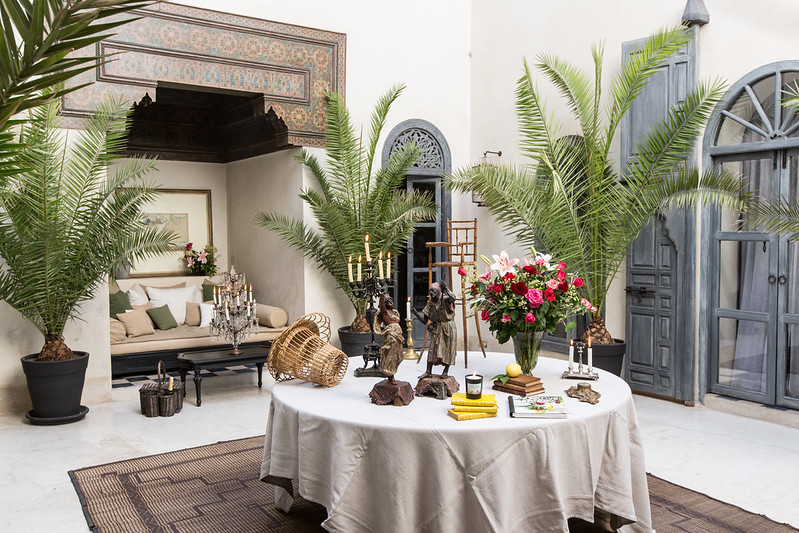
Built around three courtyards, Tarabel Marrakech has been a labour of love since 2007, as five interconnecting riads have been “merged” into one seamless mansion. Step through the unassuming door into the central courtyard, with its neat orange trees and finely furnished porticos and grand salons, and it feels like stepping into a painting.
The renowned interior decorator Rose Fournier, has an eye for exquisite detail, texture and colour. She curates her interiors, juxtaposing fine furniture and antiques with witty flea market finds. The property has evolved over the years to become one of the most desired hotels in the city.
Rooms and suites are individually and beautifully decorated, showcasing Rose’s collecting passions. Details include enormous beds (some carved four-posters), botanical prints, Chinese lanterns, rattan peacock chairs, tiled floors, antique maps and troupe l’oil paintings. Each room features two showers and a roll-top bath and an open-fire (for cooler evenings).
The hotel is 15 minutes by car from the airport. When you arrive, you are escorted down a narrow lane (a stone-throw from the legendary royal palace, Dar El Bacha Palace) to the entrance of the riad. The first thing you notice is the delicious scent of amber and orange blossom, and the delicate sound of running water from the fountains. In the evening the property is entirely candle lit.
The unique mix of authentic Moroccan tradition and the refinement of the Napoleonic style make this a very special place, with plaster columns, hand-painted wooden ceilings (mirroring Morocco’s traditional zwak patterns), and decorative tiling. There are Second Empire frescoes and paintings, and freshly cut flowers throughout the riad.
Verdant planting creates a real oasis. There’s a ground-floor swimming pool and a smaller granite black pool on the roof terrace, set with comfortable sofas and daybeds. But also large patios, terraces and open lounges for sunbathing/relaxing to ensure no one is ever on top of anyone else. And there’s a separate bar area for alfresco drinks. Guest are invited to simply unwind where they want, when they want.
Breakfast on the rooftop (or by the fire in winter) includes freshly baked breads, pastries, Moroccan pancakes, fresh fruit, eggs to order and yoghurt. Breakfast tables are spaced out so again guests feel a true sense of privacy.
The restaurant is open daily with a varied selection of Moroccan dishes, based on fresh seasonal products available in Marrakech’s kaleidoscopic souks. But “break out” areas around the riad mean you can dine alone as a couple, whether on one of the roof-top terraces, or in the summer salon decorated with hand-painted Zuber wallpaper. The idea is to maintain as much privacy as possible.
There’s a bijoux gift shop where you can purchase hand-crafts and Fleur d’Orange Tarabel’s specially created hotel fragrance and hand soaps.
Tarabel’s pièce de résistance is the gorgeous hammam and spa (“Les bains de Tarabel”), accessed through a secret, mirrored door. Welcomed by the wonderful Rkia, who manages the spa, you know you are in safe hands. The hammam and spa also has a separate entrance for non hotel guests.
For Rkia, the secret of a memorable treatment is the bond created between therapist and guest. Every treatment is perfectly tailored to the individual needs of your body. Les bains de Tarabel have partnered with Nectarome, one of the most prestigious, high-end, all-natural Moroccan brands. The spa is open 11am-8pm. There are two hammams, and three massage rooms, including two for couples. Treatments range from traditional hammam rituals and invigorating/relaxing massages, to foot and back reflexology, and manicures/pedicures (using pelargonium salts for exfoliation).
Tarabel’s mantra is: anything is possible, at any time. It’s luxurious enough to make you feel utterly spoilt. Yet wonderfully authentic to the true Morocco.
B&B is priced from around €350 per room per night
From the across the UK Marrakech is served by direct flights with BA, easyJet, Jet2, Ryanair, TUI and WIZZ Air
From Ireland Marrakech is served by direct flights with Aer Lingus and Ryanair
